A novel siRNA design technology that replaces three nucleotides in the seed region with DNA, enabling enhanced gene-silencing activity at low concentrations while minimizing off-target effects. By requiring only minimal nucleotide modifications, this approach provides a new strategy for achieving improved efficacy.
Nitto’s Seed Region DNA Modification Technology is an innovative siRNA design platform that replaces three nucleotides in the seed region of the siRNA (small interfering RNA) guide strand with DNA, enabling enhanced silencing activity at low concentrations. While extensive DNA substitution within the seed region has traditionally been associated with reduced activity, Nitto’s approach uses minimal DNA modification to improve gene-silencing efficacy while reducing off-target effects. Nitto welcomes discussions on applying this technology to existing siRNA assets and on licensing opportunities.
 |
Achieving robust gene silencing at low concentrations is a key objective in siRNA therapeutic development. Enhanced activity in the picomolar (pM) range can significantly improve the performance of siRNA candidates while potentially reducing the amount of drug required to achieve therapeutic efficacy.
At the same time, partial recognition of non-target messenger RNAs (mRNAs) by the guide strand seed region may result in miRNA (microRNA)-like off-target effects. Therefore, siRNA design strategies that combine high silencing activity with minimized off-target effects are increasingly important.
In addition, conventional optimization approaches often require extensive sequence screening and evaluation of specialized chemical modifications. When considering the transition from research and development to manufacturing, factors such as design reproducibility, availability of raw materials, and ease of integration into existing oligonucleotide synthesis processes are also important considerations.
Nitto's Seed Region DNA Modification Technology selectively replaces three nucleotides within the seed region (positions 2-8) of the siRNA guide strand with DNA. The substitutions are introduced at positions 3, 5, and 7 or at positions 4, 6, and 8, while maintaining the overall siRNA structure.
Because the seed region is responsible for target mRNA recognition by the RNA-induced silencing complex (RISC), precise modification of these positions can influence both silencing activity and target specificity.
Partial DNA substitution within the seed region can alter the thermodynamic characteristics of target mRNA binding, potentially reducing miRNA-like off-target effects. These modifications may also affect multiple steps in the RNAi pathway, including selective guide-strand incorporation into RISC, target mRNA recognition and cleavage, and overall gene-silencing efficiency.
Nitto's Seed Region DNA Modification Technology has been shown not only to reduce off-target effects but also to maintain siRNA potency and, in some cases, improve gene-silencing activity. While these benefits have been experimentally observed, the detailed mechanism responsible for the enhanced activity has not yet been fully understood.
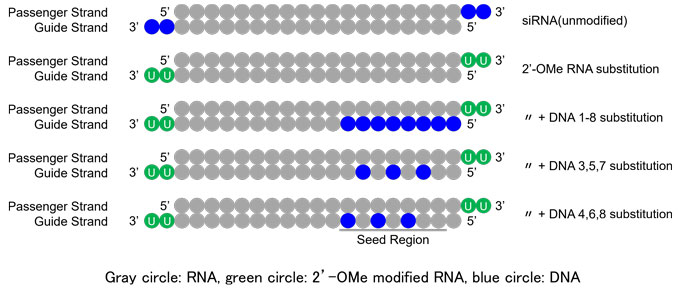 DNA Substitution Patterns in the siRNA Seed Region |
This approach does not require specialized modified nucleotides. Instead, it selectively replaces specific nucleotides within the siRNA seed region with DNA.
As the technology is based on DNA substitution, it is compatible with a wide range of other nucleic acid modifications, including GNA (Glycol Nucleic Acid), UNA (Unlocked Nucleic Acid), and 2′-5′ RNA (2’-5’ linked RNA), which have been reported to reduce off-target effects. This compatibility provides additional flexibility for siRNA optimization and development.
Enhanced siRNA activity has been observed across multiple target genes. In some cases, seed region DNA modification has demonstrated a 2- to 24-fold increase in silencing activity compared with unmodified siRNAs.
Because this technology is based on structural design rules that focus on substitution positions within the seed region rather than on specific nucleotide sequences, it has the potential to be applied across a wide range of target genes and siRNA sequences. This position-based design strategy enables broader applicability beyond individual sequence optimization.
This design strategy primarily focuses on enhancing siRNA activity while aiming to balance improved potency with the reduction of seed-dependent off-target effects.
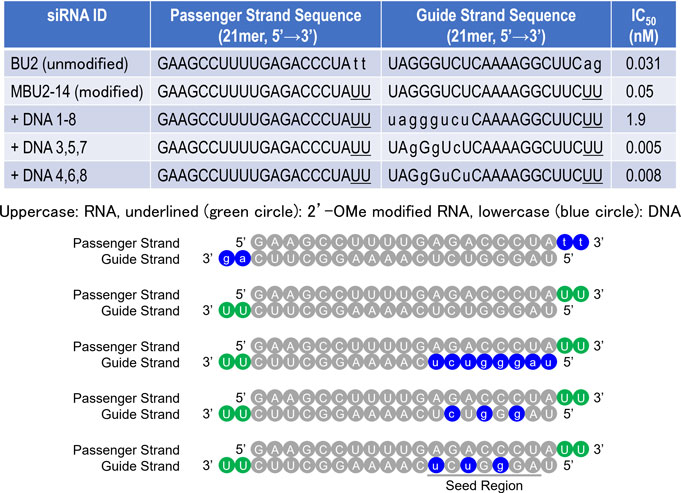 Gene-Silencing Activity of Seed Region DNA-Modified siRNAs |
| Comparison Criteria | Conventional DNA Modification | Nitto’s Seed Region DNA Modification |
|---|---|---|
| Modification Strategy | Approximately one-third of the guide strand from the 5′ end is substituted with DNA | Three specific nucleotides within the seed region (e.g., positions 4, 6, and 8) are substituted with DNA |
| Substitution Scope | Extensive DNA substitution across multiple nucleotides | Targeted substitution of three specific nucleotides |
| Potency at low concentration | May result in reduced siRNA activity | Maintained or enhanced activity while aiming to reduce seed-dependent off-target effects |
| Applicability Across Target Sequences | Requires sequence-specific optimization of the substitution range | Potential applicability based on the 3-5-7 or 4-6-8 substitution patterns |
Without being restricted to specific disease areas, this technology has the potential to support the development of siRNA therapeutics that require improved activity at low concentrations and reduced off-target effects. Potential applications include the design of next-generation siRNA medicines for a wide range of indications, such as cancer, fibrosis, and rare diseases.
Seed-region DNA substitution patterns may serve as an additional design parameter for siRNA platforms, supporting the development of more advanced design strategies aimed at balancing potent gene knockdown at low concentrations with reduced off-target effects.
For oligonucleotide therapeutics pipelines facing challenges related to lead candidate potency or nonclinical safety profiles, this technology may serve as an additional optimization option. Applying seed-region DNA substitution to existing siRNA sequences enables comparative evaluation of knockdown efficiency and potential off-target effects, supporting candidate optimization and decision-making.
For therapeutic programs targeting extrahepatic tissues, increased dosing requirements may raise concerns regarding off-target effects. In such cases, seed-region DNA modification can be considered as an additional siRNA design strategy alongside delivery technologies, supporting the evaluation of both potency and specificity.
For programs where access to specialized amidites or increased synthesis complexity presents development and manufacturing challenges, seed-region DNA modification may offer a practical alternative based on standard DNA building blocks. The approach can be assessed for its manufacturing feasibility and considered as an additional option for supporting customer design and optimization proposals.
The potential applications of this technology extend beyond the examples presented here, encompassing diverse target sequences, delivery platforms, and therapeutic areas. By making this patented technology available for licensing, Nitto aims to offer researchers and developers a new design option for advancing oligonucleotide therapeutics.
Nitto has focused on improving siRNA activity while reducing off-target effects as fundamental challenges in oligonucleotide therapeutics development. Through the advancement of siRNA therapeutic candidates for indications including lung cancer and liver cirrhosis into clinical trials, Nitto has accumulated extensive expertise in sequence design, chemical modification, and activity evaluation. These experiences provide valuable technical insights that support the development of next-generation oligonucleotide therapeutics.
Leveraging the expertise gained through its oligonucleotide therapeutics research programs, Nitto welcomes discussions regarding the applicability of this technology to customers’ siRNA sequences and development candidates, as well as licensing opportunities related to the technology.
 |
Nitto holds a patent portfolio covering siRNA design strategies based on DNA substitution at specific positions within the seed region. Licensing opportunities are available for organizations seeking to apply this technology to RNAi drug discovery platforms, oligonucleotide therapeutics pipelines, extrahepatic delivery and DDS technologies, as well as custom oligonucleotide synthesis services.
| Patent No | LINK | Others |
|---|---|---|
| US10358647 | LINK of patent information | ― |
Nitto's patented seed-region DNA modification technology is protected by granted patents in 24 countries and regions, including Japan (JP6457704), the United States (US10358647), Europe (EP3386519), South Korea, Taiwan, Hong Kong, India, Canada, and Australia.
* The information contained on this page is current as of the date of publication. Patent ownership, legal status, and other related information may change over time. Please consult official patent databases and other authoritative sources for the most up-to-date information.
The following is an example of the flow for utilizing Nitto's patents.

Nitto is looking for partners and companies who want to use our patents to create a better future together.
If your company is interested in using Nitto's patents, please contact us through the inquiry form.
Intellectual Property Department 3, Technology and IP Strategy Division