The Nitto Group's manufacturing is based on the use of the Earth's limited natural resources, and we believe that the efficient use of resources is our corporate mission. In addition to reducing waste through waste management and efficient resource utilization at each business location, we will promote technological development for resource circulation, aiming to realize a recycling-oriented society.
Many Nitto Group products use raw materials derived from fossil fuels. Therefore, we are advancing the procurement of environmentally responsible raw materials while transforming our manufacturing processes to maximize the effective use of those materials. By optimizing production processes to improve yield rates, we are reducing waste at its source and promoting the efficient use of resources. In addition, we regard waste as an untapped resource and are advancing circular use through thorough waste separation and recycling initiatives.
We have set environmental targets of a resource utilization ratio of at least 69% and a sustainable materials procurement ratio of at least 30% by fiscal 2030. We are steadily progressing toward these targets primarily through the effective use of resources—including product design (weight reduction and yield improvement), reuse, and recycling—as well as the use of biomass and recyclable materials with low environmental impact.
Resource circulation target
| Targets for FY2030 | |
|---|---|
| Resource utilization ratio | 69% or more |
| Sustainable materials procurement ratio | 30% or more |
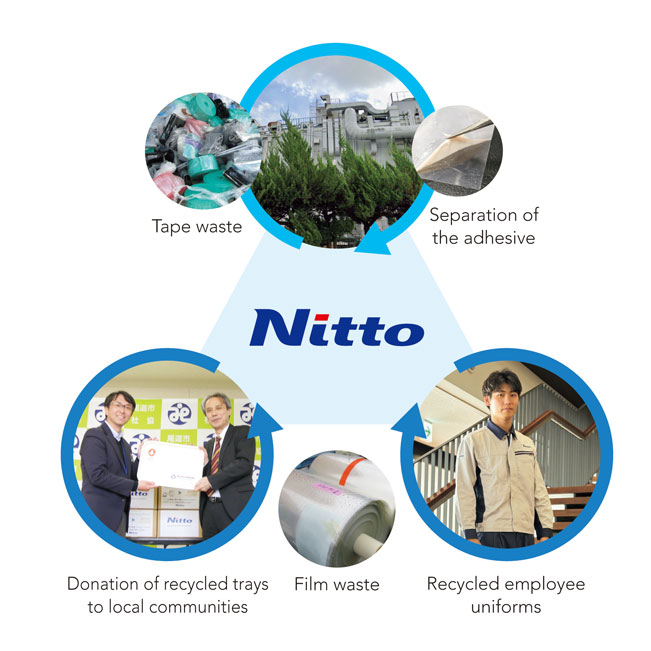
The Nitto Group is working to realize a sustainable circular society by periodically assessing and analyzing the volume, types, and sources of waste generated at each of its manufacturing sites. Focusing particularly on plastic waste—which accounts for approximately 50% of all waste—we conduct detailed analyses of discharge patterns and sorting practices during manufacturing processes to identify the primary causes of waste generation, challenges in recycling, and opportunities for improvement aimed at reducing waste and promoting resource recovery. Based on the challenges and areas for improvement identified through this process, we are advancing concrete initiatives to reduce waste, improve recycling rates, and achieve an efficient resource cycle. These include developing technologies to separate adhesives from base materials for recycling (monomaterialization) and ensuring thorough on-site sorting by material type.
Many of our products are composite materials consisting of plastic films laminated with adhesives and materials with optical properties. While these products deliver advanced functionality, their composite structure has made recycling difficult and has long remained a challenge.
Addressing this challenge requires separating materials into their individual components (monomaterials). In particular, adhesive separation technology, which helps prevent quality degradation and limitations on the use of recycled materials, is positioned as a key technology for realizing a circular economy. Against this backdrop, the Nitto Group has been developing adhesive separation technologies since fiscal 2021. In fiscal 2025, a pilotscale demonstration facility was introduced at our Toyohashi Plant, and testing toward commercial-scale production commenced. We will continue to accelerate these efforts to achieve our fiscal 2030 targets of a 60% waste plastics recycling ratio and a resource utilization ratio of 69% or higher.
We are also undertaking initiatives to enhance the value of waste plastics. In fiscal 2025, we produced plastic trays using sorted and collected waste film as a raw material, and these trays were used at Expo 2025 Osaka, Kansai, Japan. After the Expo concluded, the trays were donated to local schools and other community organizations, while additional materials were recycled into drainage pipes used to improve water runoff at facilities such as sports grounds. In addition, materials made from 100% Nitto Group waste plastics have been incorporated into the plastic components of employee uniforms, with deployment already underway at certain locations. We plan to expand the use of these materials going forward.
In line with the policy of “contributing to customer CO2 emission reduction through products and solutions” set out in the Declaration of Nitto Group Carbon Neutral 2050, the Nitto Group is positioned to address challenges across the supply chain and society as a whole by leveraging the resource-circulating technology it has developed.
 |
Since a large amount of GHG is emitted during the combustion of solvent gases, we have installed solvent recovery equipment. Recovering solvents not only reduces GHG emissions, but also leads to more efficient use of resources. We are developing processes that do not use organic solvents, and are promoting the recycling of used solvents that are collected after use.
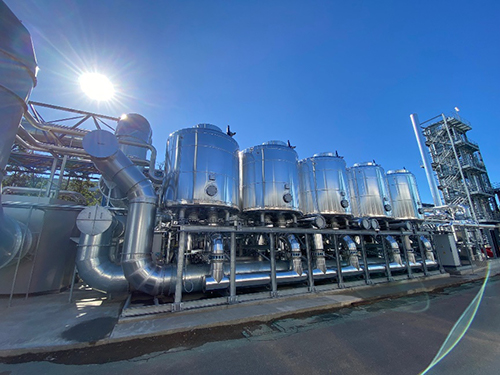 Photo: Solvent recovery system at Nitto Belgium |
Many Nitto Group products use raw materials derived from fossil fuels. To deliver environmentally friendly products to customers, we have increased the proportion of recycled and biomass-derived materials in our procurement. As part of our effort to transition to sustainable raw materials, we also began procuring certified raw materials for polysulfone and ethyl acetate using the mass balance method*. Furthermore, at a site in Europe, we have transitioned to 100% biomass-derived ethyl acetate. By continuing to refine our raw materials strategy and strengthen collaboration with suppliers, we will further advance initiatives that contribute to resource circulation and the expanded use of renewable resources.
* The mass balance method is a certification approach that assigns specific attributes (e.g., biomass-derived content) to a portion of the final product based on the proportion of input materials, used when they are mixed with conventional materials (e.g., petroleum-derived content).