 |
Our advertorial article, titled “Accelerating carbon capture using membranes,” was published on 21 May 2026 , as part of Nature Index Chemistry in the online version of Nature, a weekly international journal publishing the finest peer-reviewed research in science and technology. The content of this article was originally produced in partnership with Nature Custom Media as sponsored content. Click here to view the original article.
As the world pursues carbon neutrality, industrial emissions of carbon dioxide (CO2) remain one of the most persistent barriers to achieving that goal.
A technology known as ‘carbon capture, utilization and storage’ is a key technology that can help. As its name implies, it involves capturing CO2 from sources such as industrial emissions, and then either using it in applications or storing it. However, several technological and economic hurdles currently hinder its widespread adoption.
According to a projection by the International Energy Agency, to help meet global climate goals, CO2 capture capacity would need to increase dramatically to around 3.74 billion tonnes by 2050 — about 85 times the amount captured in 2022.
“The development of low-cost, highly efficient CO2 capture technologies has become an urgent priority,” says Terukazu Ihara, general manager of separation technology research at Nitto, a manufacturer of high-performance materials based in Osaka, Japan.
CO2 capture technologies have evolved considerably over the past few decades. In the 1990s and 2000s, the dominant approach for capturing carbon was chemical absorption using aqueous amine solutions. In this process, CO2 in exhaust gas reacts with an amine solvent to form a soluble compound, allowing it to be separated from nitrogen and other gases.
However, regenerating the solvent requires substantial thermal energy, making the technology most suitable for large-scale CO2 sources such as steel and power plants. For smaller facilities, including materials and chemical plants, the process is too costly and operationally challenging, partly due to secondary emissions generated during thermal solvent regeneration.
“Major industrial sources have been the primary focus of innovation and investment,” says Ihara. “But it’s also important to address smaller operations, which often require different technological approaches.”
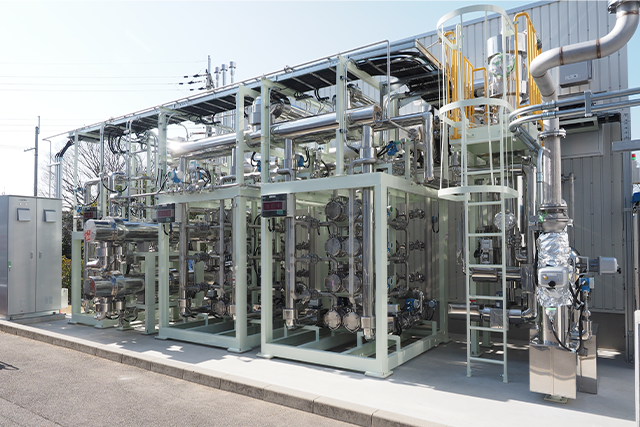
Nitto is helping to address this need by bringing a selective gas permeation method to the market. It uses ultrathin membranes designed for small scale installations, a technique that has been gaining momentum since the 2010s. It enables CO2 capture powered by electricity, avoiding the thermal energy required in conventional amine systems. This is a more efficient approach, and the electricity can be generated from renewable sources.
“This approach offers many advantages, including energy savings, a compact design and strong potential for scalable mass production,” says Ihara.
Nitto has gained considerable expertise in manufacturing membranes as the result of developing water-treatment technologies for more than five decades. “This background has given us a strong foundation for deploying our membrane technologies in decarbonization,” says Yuya Kitagawa, director of Nitto’s Corporate Business Development Division.
Typical size-selective membranes are not very effective for CO2. “Most conventional membranes act as molecular sieves, separating gases by size,” explains Ihara. “However, in the exhaust streams we target, CO2 and nitrogen molecules are nearly identical in size, requiring a fundamentally different approach.”
Many materials that have been explored for this purpose also have limitations. Inorganic membranes contain uniformly arranged nanopores that enable size-based separation, but their performance drops off when molecules are similar in size. Researchers are exploring metal–organic frameworks, which are hybrid materials known for high size- and chemical selectivity. However, they remain costly and difficult to fabricate uniformly at scale, limiting their commercial viability, Ihara says.
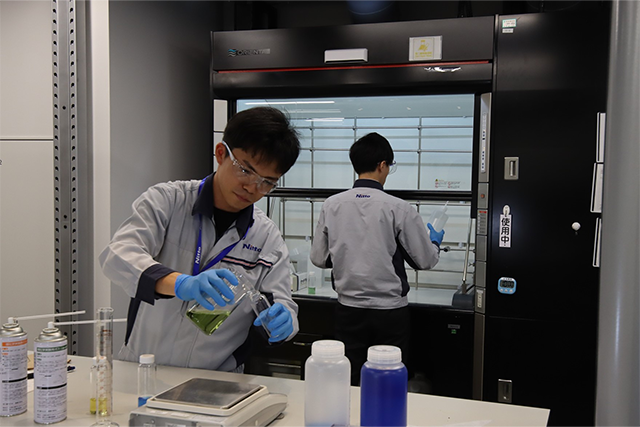 Nitto engineers conducting R&D on CO₂-capture membranes. |
To address these challenges, Nitto engineers have developed a high-performance polymer membrane. This membrane contains molecular units that interact strongly with CO2, allowing it to dissolve preferentially while limiting the solubility of gases such as nitrogen. Creating a pressure gradient across the membrane causes dissolved CO2 to diffuse through the membrane, and it can be collected on the other side.
“This solution–diffusion mechanism enables selective and efficient CO2 separation,” says Ihara.
The membranes are assembled into spiral-wound modules, a configuration used in Nitto’s water-treatment systems. Flat membrane sheets are wrapped around a central collection tube to maximize the surface area within a compact structure, enabling efficient gas flow while channeling the separated CO2 to the core for collection.
Optimal performance requires specialized fabrication techniques. The membrane is coated with ultrathin, defect-free layers to achieve high flux and selectivity in multilayer structures.
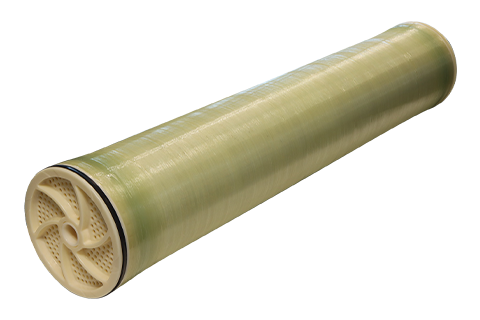 A CO₂ separation membrane module. |
Even if the technology proves viable, however, much wider deployment will hinge on demand for captured carbon. “Some applications are already available, such as CO2 for carbonated beverages, but large volume markets like synthetic fuels made from captured CO2 are still emerging,” says Kitagawa. Storage infrastructure, regulatory frameworks and the costs of capture and transport also pose major hurdles, he adds.
Despite technical and commercial challenges, Nitto remains committed to advancing next-generation membrane technologies. As part of this effort, the company is expanding its partnerships, including a collaboration with an overseas startup to develop carbon-capture solutions for medium-scale emission sources such as power plants.
The company’s longer-term ambitions extend beyond membrane-based CO2 separation, guided by its 2022 pledge to pursue only technologies aligned with environmental, social and governance principles.
“Our goal is to develop a portfolio of technologies that together can enable ‘carbon neutrality’,” explains Kitagawa. One concept being looked at would combine captured carbon with hydrogen-based fuels and returning the resulting energy carriers to factories, creating a more circular carbon flow.
“Before the 2015 Paris Agreement, we didn’t fully envisage the scope of our work,” says Ihara. “But over time, the path has become much clearer, and we’ve developed a stronger sense of our responsibility to help shape a better future.”
 |