Nitto's wet adhesion technology not only bonds while removing water from surfaces, but also encompasses moisture-curing, water-resistant, NCO (isocyanate)-free design, and swelling-triggered debondable adhesive technologies according to application requirements. We welcome licensing inquiries from material manufacturers, repair-material suppliers, and other companies interested in utilizing these technologies.
Wet adhesion technology addresses the challenge of bonding to wet surfaces and underwater environments. Rather than simply removing water from the substrate surface, this technology utilizes moisture to cure the adhesive, enabling reliable bonding on wet surfaces and even underwater. Nitto owns a range of patents covering moisture-curing, water-resistant, and NCO-free wet adhesion technologies. We welcome inquiries regarding patent licensing from companies interested in incorporating these technologies into pressure-sensitive adhesive (PSA) tapes, PSA materials, and related products.
Conventional PSA tapes and adhesive materials may exhibit reduced adhesion and holding power when water remains on the substrate surface, as the water layer interferes with direct contact between the adhesive and the substrate. This challenge is particularly significant for substrates with microscopic surface irregularities, such as concrete and wood. Water tends to remain trapped within surface depressions, making it difficult for the PSA layer to conform to the substrate and achieve sufficient contact.
As a result, it may be necessary to dry the surface or apply a primer before bonding, which can increase installation time and add process steps. Effective bonding to wet surfaces requires more than simply addressing surface water. The PSA must be designed to conform to surface irregularities, maximize contact area, and maintain adhesion under wet conditions through appropriate material and structural design.
In addition, growing attention to chemical regulations and safe handling practices has increased demand for wet adhesion technologies that do not use NCO compounds. NCO-free material designs expand the range of materials available for product development by providing the performance required for wet adhesion while supporting regulatory compliance and safer handling considerations.
 |
Nitto's wet adhesion technology is designed to address water present on bonding surfaces through both material and structural design. Water-absorbing materials take up surface water, allowing the PSA layer to make closer contact with the substrate. Soft materials conform to surface irregularities, while striped patterns and multilayer structures provide pathways for water to escape.
In moisture-curing systems, absorbed water reacts with the NCO groups, enabling the PSA layer to build adhesion strength progressively over time. Nitto also develops designs to suppress excessive water-induced swelling, as well as NCO-free designs that leverage interactions with water. A key feature of these technologies is the ability to combine different approaches to adhesion initiation, adhesion retention, and debonding according to application requirements.
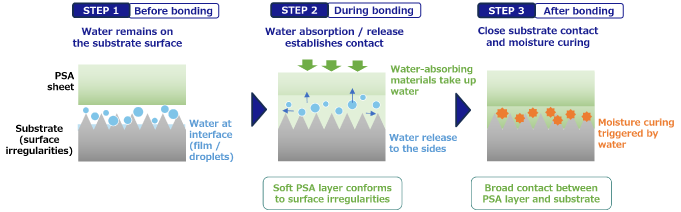 Mechanism of bonding on wet surfaces |
Designed for environments where water remains on the bonding surface, this technology uses water-absorbing materials and water-release structures to ensure contact between the PSA layer and the substrate. It can reduce the need for surface drying or primer application before bonding, helping simplify installation processes.
Water-absorbing materials not only remove water from the surface but also use that water to initiate moisture curing of NCO groups. This approach first establishes contact with the substrate and then strengthens adhesion over time.
A soft PSA layer conforms to fine surface irregularities on the substrate. Stripe patterns and multilayer structures provide pathways for water to escape, enabling both adhesion and holding power on wet surfaces. By controlling the degree of swelling, excessive water absorption in underwater environments can be suppressed, helping prevent material debonding.
This technology utilizes catechol-like functional groups and highly hydrophilic acrylic copolymers without the use of NCO. It can accommodate applications where the use of NCO is undesirable, expanding the range of available material options.
Nitto's wet PSAs not only improve adhesion in the presence of water, but also manage residual water during application and maintain holding power during use. Furthermore, water management, curing, water resistance, and debonding may each be achieved through different design approaches.
| Comparison Item | Common PSAs | Nitto's Wet Adhesion Technology |
|---|---|---|
| Bonding to Wet Surfaces | Difficult to achieve intimate contact due to the presence of a water layer | Water-absorbing materials and water-release structures help ensure contact |
| Changes in Adhesion Strength | Adhesion strength may decrease under prolonged wet conditions | Incorporates a moisture-curing design triggered by water |
| Conformability to Surface Irregularities | Depends on the softness of the material | Soft PSA layers and structural design improve conformability |
| Underwater Durability | Excessive water absorption may lead to debonding | Water-resistant designs with controlled swelling |
| NCO-Free Design | Varies depending on formulation | Incorporates designs utilizing catechol-like functional groups and highly hydrophilic acrylic copolymers |
This technology is expected to find applications where bonding on wet surfaces or underwater is required. In particular, potential applications include PSA tapes and PSA materials that require initial adhesion on wet surfaces, maintaining adhesion underwater, and NCO-free designs.
When developing materials for use on wet surfaces or underwater, factors such as initial adhesion immediately after application, storage stability, and long-term water resistance must be considered. Nitto holds patents related to wet adhesion technologies, including moisture-curing, swelling-suppression, and NCO-free designs. We welcome patent licensing inquiries from companies interested in applying these technologies to the development of your films, sheets, tapes, and other materials.
For applications involving concrete after rainfall, road repair, and underwater structures, drying the surface or applying a primer before installation can increase process burdens. Features such as bonding to wet surfaces and conformability to surface irregularities are expected to support applications including water-stopping, surface protection, and repair materials.
 |
In the future, material designs may also utilize water-induced swelling to facilitate debonding and enable easier removal when needed. Such designs may find applications in temporary bonding materials for semiconductor manufacturing processes involving water or chemical solutions. However, application to semiconductor manufacturing requires case-by-case evaluation, including process conditions and the required debonding performance.
Nitto holds the following patents related to bonding to wet surfaces, moisture curing, water resistance, and NCO-free designs. We welcome patent licensing inquiries from companies interested in incorporating functions such as bonding to wet surfaces, underwater adhesion retention, NCO-free designs, and swelling control into your PSA tapes, PSA materials
| Patent No | LINK | Others |
|---|---|---|
| JP7168314 | LINK of patent information | ― |
| JP7609778 | LINK of patent information | ― |
| JP7712083 | LINK of patent information | ― |
| JP7203492 | LINK of patent information | ― |
| JP7359570 | LINK of patent information | ― |
* The information on this page is based on information available at the time of publication. Please refer to official databases and other public sources for the latest patent status and related information.
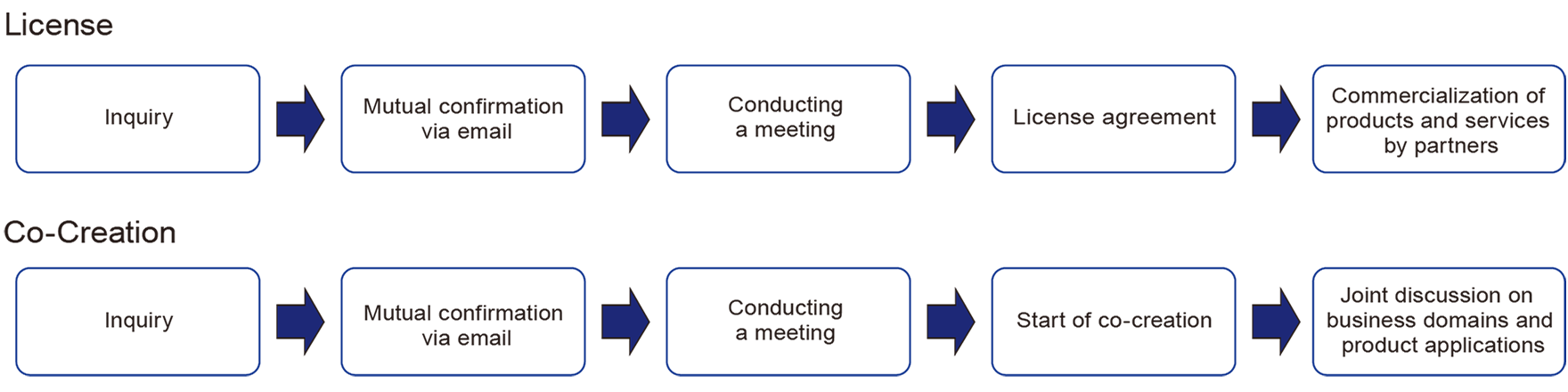
The following is an example of the process for licensing and utilizing Nitto's patents.
Nitto is looking for partners and companies who want to use our patents to create a better future together.
If your company is interested in using Nitto's patents, please contact us through the inquiry form.
Intellectual Property Department 3, Technology and IP Strategy Division